In theory, saving money should be simple.
You earn. You subtract your expenses. You save the rest.
But in reality, many people in Kenya feel like money disappears before they can even think about saving.
This is not just personal discipline. It is a system problem.
Mobile Money Changed How We Spend
Before mobile money, spending required effort. You had to physically withdraw cash, count it, and hand it over.
That friction created awareness.
Today, with M-PESA and other digital payments, spending is instant:
- Send money in seconds
- Pay bills instantly
- Buy goods without thinking twice
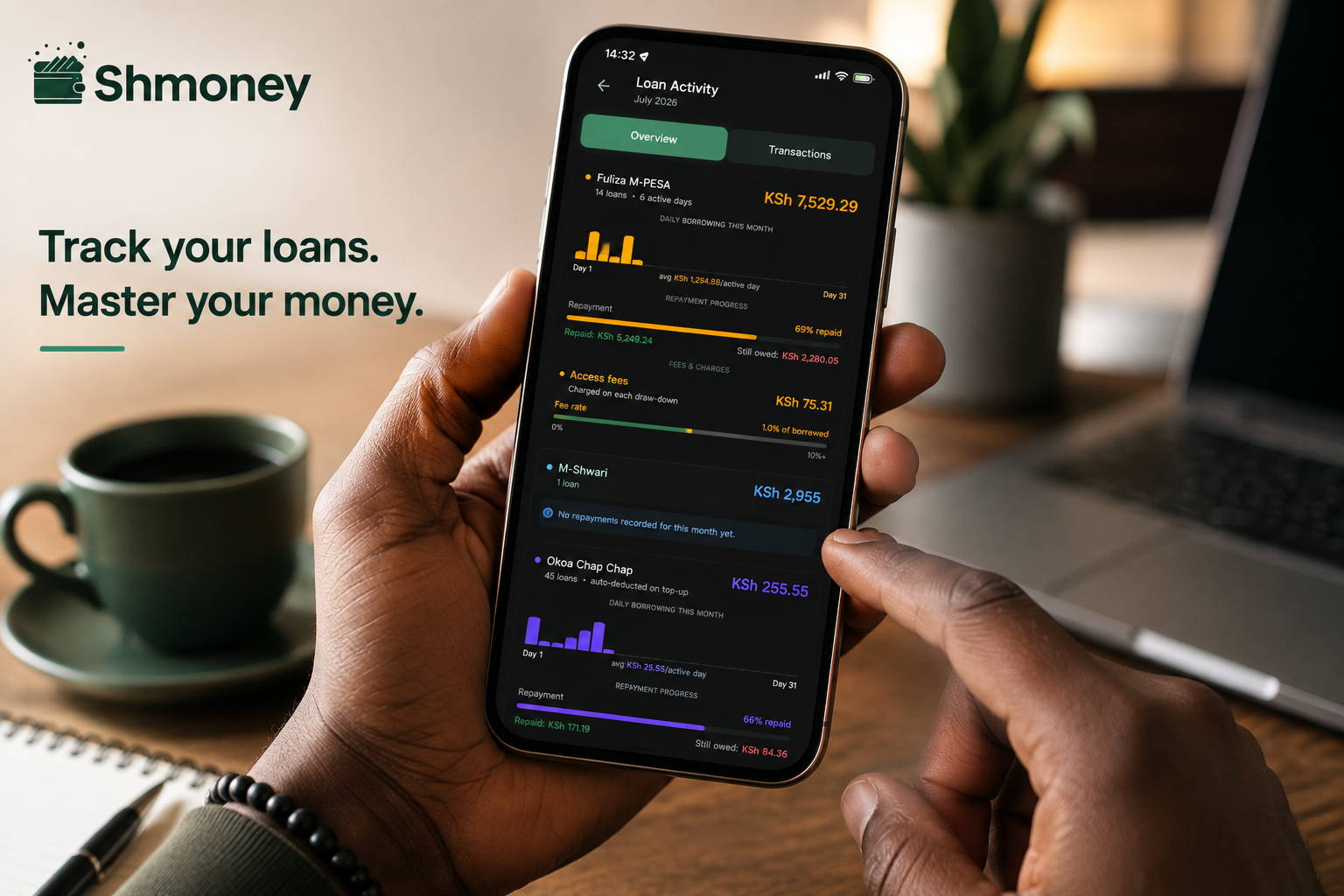
- Borrow instantly using Fuliza
Spending has become frictionless — and that is the problem.
Why Saving Feels Harder in 2026
The issue is not that people are earning less. It is that money is moving faster than awareness.
Small transactions no longer feel like spending.
A KSh 200 payment feels insignificant. But repeated 20–30 times a week, it becomes a major expense.
This is what makes saving difficult — not lack of income, but lack of visibility.
The Hidden Psychology of Digital Spending
Mobile money removes emotional friction from spending.
When cash leaves your hand, you feel it.
When a number changes on your phone screen, you don’t.
This shift creates three problems:
- You underestimate small expenses
- You forget transactions quickly
- You lose track of total monthly spending
Over time, this creates the feeling that money “disappears.”
The Fuliza Trap: When Borrowing Becomes the Default
Fuliza launched in 2019 and quickly became one of the most-used financial products in Kenya. It was designed as an emergency overdraft — a bridge to cover a shortfall until your next income arrives.
For many people, it has become everyday spending money.
The problem is not borrowing itself. It is what Fuliza costs when it runs continuously. Keep KSh 1,000 on Fuliza for a whole month and the fees come to about KSh 172. Keep KSh 2,000 for a month and it is about KSh 740, on that one balance alone. Repay the same KSh 1,000 within 3 days and you pay only the KSh 10 access fee. (Check any amount with the Fuliza calculator.) Most people never see this number because Fuliza charges deduct automatically from the next top-up — there is no bill, no statement, no moment where you feel the cost.
When borrowing is instant and repayment is invisible, the line between your income and your debt disappears. That is a direct obstacle to saving.
Why Irregular Income Makes Saving Harder
A large share of workers in Kenya — market traders, boda boda riders, contractors, domestic workers, freelancers — do not receive a fixed monthly salary. Income arrives in bursts: a large payment one week, nothing the next.
Standard budgeting advice ("save 20% of your income each month") was built for salaried employment. It does not translate well to variable income, where you do not know what this month's total will be until it is already spent.
What works better for irregular income is percentage-based saving: when any amount arrives, move a fixed share — even 5 or 10 percent — to savings immediately, before it mixes with daily spending. Even KSh 500 saved on a KSh 10,000 payment adds up. Twelve months of that habit is KSh 6,000 set aside without feeling it.
Why Budgeting Alone Is No Longer Enough
Traditional budgeting assumes you know what you spend.
But most people don’t actually see their full spending pattern until the end of the month — or never at all.
By then, the money is already gone.
This is why manual budgeting often fails in a mobile money economy.
What Actually Needs to Change
The problem is not spending itself.
The problem is lack of real-time financial visibility.
To save consistently, you need to understand:
- Where your money is going as it happens
- Which categories consume most of your income
- How fast your spending is growing during the month
Practical Saving Strategies That Work in Kenya
None of these require a formal bank account or a large starting amount:
- M-Shwari lock savings — M-Shwari Lock Savings lets you lock money away for 1 to 6 months, with no charges. Setting up a lock on the 1st of each month turns saving into a default rather than a decision. Even KSh 500 locked for a month builds a habit faster than trying to resist spending it, and an early withdrawal takes 48 hours, which is usually long enough to change your mind.
- The 72-hour rule for non-essential purchases — Before any M-PESA payment above KSh 1,000 that is not food, transport, or a bill, wait 72 hours. Write down what you wanted to buy, revisit it on day 3. Most impulse spending disappears on its own without any willpower required.
- Chamas with a specific goal — The traditional chama model works well for people who struggle to save alone. Social accountability — not wanting to be the person who skips a contribution — often does more for saving habits than individual willpower. A goal-based chama (a specific trip, a business purchase, school fees) has better completion rates than a general savings pot.
- Name your savings — Calling a savings pot "December rent" or "laptop by June" dramatically increases the chance you leave it alone. When savings have a named purpose, they feel less available for other spending.
- Track before you cut — Trying to reduce spending before you understand it usually fails within two weeks. Spend one month tracking without changing any behavior. The visibility alone often reduces spending naturally — you stop making purchases you know you would be embarrassed to see categorized.
5 Ways to Save Money on M-PESA Fees
Saving is not only about putting money aside. Fees you never notice are money you never get to keep. These five changes cost nothing to make (fees from Safaricom's published tariffs):
- Withdraw once, not three times. Any agent withdrawal from KSh 101 to KSh 2,500 costs KSh 29. Three withdrawals of KSh 500 cost KSh 87. One withdrawal of KSh 1,500 costs KSh 29.
- Pay the till instead of withdrawing cash. Paying at a Lipa na M-PESA till costs you nothing as the customer. Withdrawing KSh 1,000 to pay in cash costs KSh 29.
- Watch the band edges when you send. Sending KSh 1,000 costs KSh 13, but sending KSh 1,001 costs KSh 23. Sends of KSh 100 or less are free. Check any amount with the M-PESA charges calculator.
- Clear Fuliza within 3 days. Balances up to KSh 1,000 have no daily fee for the first 3 days, so KSh 1,000 repaid within 3 days costs KSh 10. Kept for a month, it costs about KSh 172. See every Fuliza loan you have taken.
- Know your monthly fee total. Most people guess low. Work out what you pay in M-PESA fees each month, then decide which habit to change first.
Why I Built Shmoney
Shmoney was built from a simple frustration: money moves too fast in mobile money systems to track manually.
Most people rely on memory, guesswork, or end-of-month statements — all of which come too late.
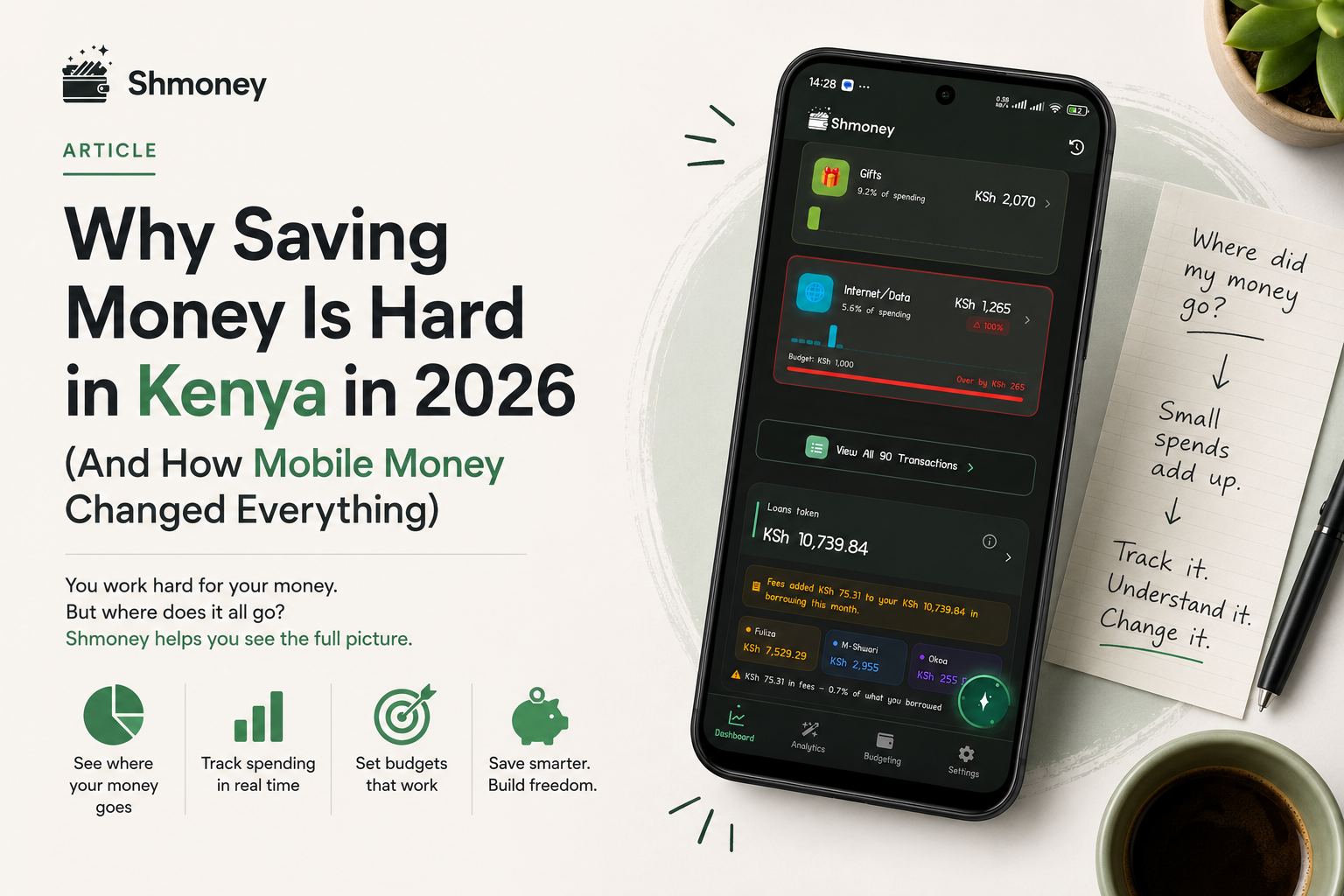
Shmoney reads your M-PESA SMS messages and turns them into a clear financial picture in real time.
Instead of asking “where did my money go?”, you can actually see it.
What Shmoney Helps You See
- Your total spending per month
- Your spending by category (food, transport, bills, etc.)
- How much you are paying in M-PESA fees
- How your spending changes over time
The goal is not to restrict spending — it is to make spending visible.
Saving Starts With Awareness
You cannot fix what you cannot see.
In a mobile money world, saving is no longer just about discipline. It is about visibility and awareness.
Once you can see your spending clearly, saving becomes a natural outcome — not a struggle.
Download Shmoney
If you want to understand where your money goes every month, start by seeing it clearly.
Download Shmoney on Google Play →
Frequently Asked Questions
Why is it hard to save money in Kenya in 2026?
Mainly because mobile money makes spending instant and less noticeable, leading to unconscious overspending.
Is mobile money the reason people overspend?
Not directly — but it removes friction, which makes spending easier and less intentional.
How can I start saving more effectively?
Start by tracking your spending in real time so you understand where your money goes before the month ends.
How does Shmoney help with saving?
Shmoney shows your spending patterns automatically so you can identify unnecessary expenses early and adjust before it's too late.
What is a good savings rate in Kenya?
Financial guidance often suggests 20% of income, but this is a goal, not a minimum. If 20% is not currently possible, 5–10% saved consistently beats nothing saved while aiming for a perfect ratio. The key is automation: saving before the money reaches your spending account.
How can I save money on M-PESA fees?
Withdraw cash less often (any withdrawal from KSh 101 to KSh 2,500 costs KSh 29), pay at Lipa na M-PESA tills instead of withdrawing, check send amounts near band edges (KSh 1,000 costs KSh 13 to send, KSh 1,001 costs KSh 23), and clear Fuliza balances of up to KSh 1,000 within 3 days to avoid daily fees.
How does Fuliza affect my ability to save?
Fuliza charges deduct from your next top-up automatically, which means they reduce your effective income without feeling like a separate expense. If you are regularly using Fuliza, the daily charges can add up to hundreds of shillings a month — money that could be going toward savings instead. Tracking Fuliza charges as a separate category is the first step to reducing them.
What is M-Shwari and can it help me save?
M-Shwari is a mobile savings and loan product from Safaricom and NCBA, accessible directly from M-PESA. Lock Savings lets you lock money away for 1 to 6 months with no charges, and M-Shwari savings earn interest of up to 6.3% a year. It is one of the simplest ways to separate savings from daily spending in Kenya.
How do chamas help with saving?
Chamas use social accountability to maintain saving discipline. When you contribute to a group, the social commitment often prevents skipping in a way that individual willpower does not. The rotating payout model — where each member receives the full pot in turn — also delivers a large lump sum that is easier to put toward a goal than the same amount saved gradually.